

Gun Silencer & Suppressor Solutions

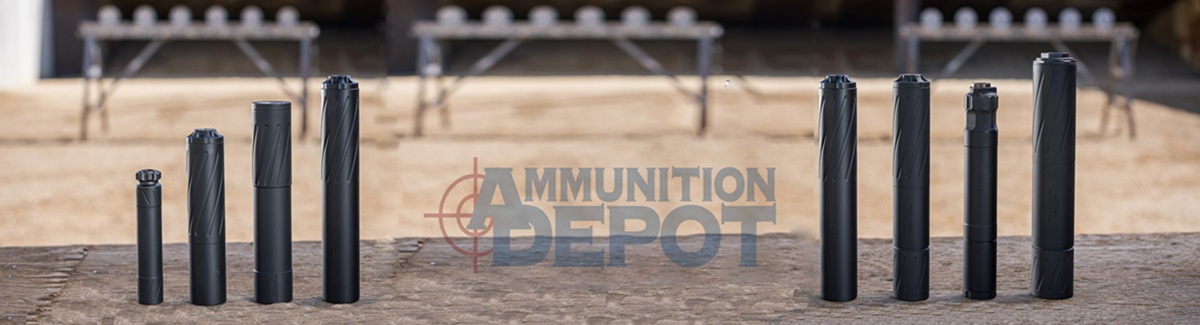
Your one-stop source of information for all things silencer and suppressor related.
From selection and compatibility to legality and ATF paperwork. At Ammunition Depot, we help shooters find the right suppressor for pistols, rifles, rimfire firearms, and shotguns, while guiding you through every step of compliant ownership.
TABLE OF CONTENTS
- Find your silencer or suppressor
- How does a silencer or suppressor work?
- What's needed before adding a silencer or suppressor?
- Are silencers and suppressors legal?
- How do I buy a silencer or suppressor?
- Legal requirements for buying a silencer or suppressor?
- Fingerprints for the ATF Form 4
- Silencer / Suppressor FAQs
- Contact Information
Find Your Silencer or Suppressor
Find the Suppressor/Silencer model you're looking for by entering the information fields below.
How Does a Silencer or Suppressor Work?
A silencer (also known as a suppressor) reduces the sound of a firearm by managing the high-pressure gases produced when a shot is fired.
Rather than letting those gases escape instantly into open air, the silencer controls their release.
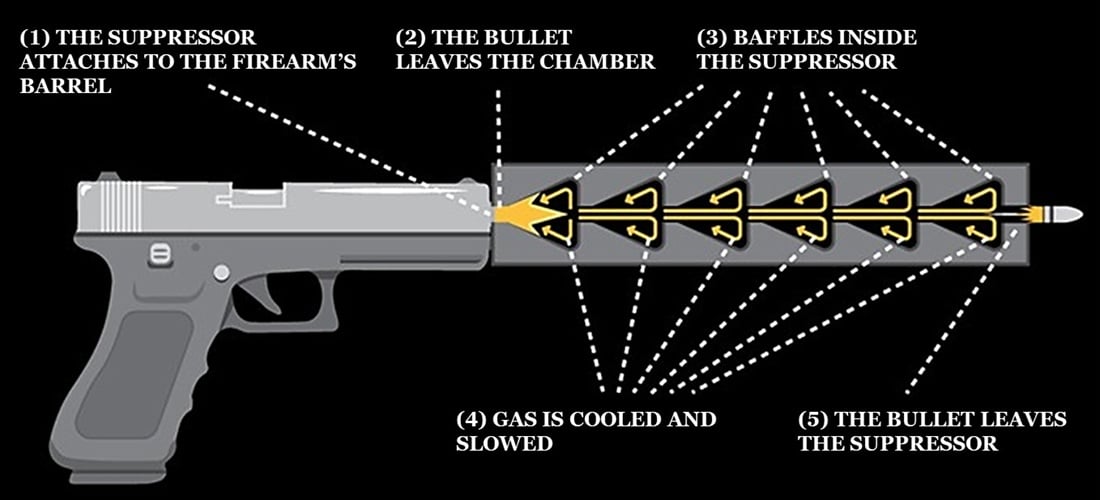
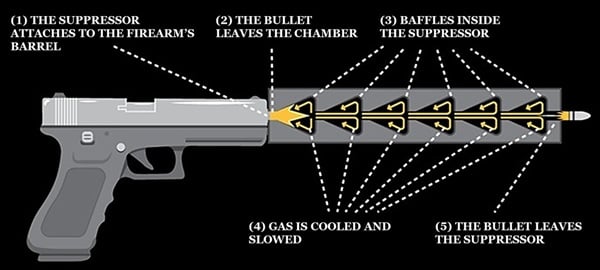
- The suppressor attaches to the firearm’s barrel. The direct thread method is the most common way to attach a suppressor to a barrel, and the suppressor simply screws on.
- The bullet leaves the chamber and travels through the firearm’s barrel, and into the suppressor. High pressure gas is released; this is one of contributing factors that causes loud noise when discharging a firearm.
- Baffles are spaced apart throughout the interior of the suppressor. These baffles are chambers that trap the high pressure gas.
- The gas is cooled and slowed while being trapped inside the chambers, this decreases the pressure and temperature.
- The bullet leaves the suppressor a much lower volume, decreasing the sound by up to 40 decibels.
In simple terms, a silencer doesn’t eliminate sound entirely, it manages gas flow and pressure to make the shot dramatically quieter and more controlled.
What's Needed Before Adding a Suppressor?
Purchasing your first suppressor is an exciting step, but it often comes with a learning curve. Unlike many firearm accessories, suppressors are not simple plug-and-play upgrades. Before choosing a suppressor, it’s essential to understand how it mounts to your firearm and whether your firearm is compatible in the first place.
This is where many first-time buyers run into confusion. Fortunately, once you grasp the core components involved, the rest of the process becomes much easier. As a quick clarification, the terms suppressor and silencer are interchangeable, they refer to the same device.
The Most Important Requirement: A Threaded Barrel
At the most basic level, a suppressor must attach to something, and that something is a threaded barrel. If your firearm does not have a threaded barrel, a suppressor cannot be mounted without modification.
This requirement applies to both rifles and handguns. Threaded barrels are manufactured with specific thread patterns that vary based on caliber and firearm type.
Some common thread standards include:
- 1/2×28 for many 5.56 rifles and 9mm pistols
- 5/8×24 for many .30 caliber rifles
Matching the thread pattern on your barrel to the suppressor or mounting system is critical. A mismatch will prevent proper installation and could cause alignment issues. Most modern rifles come from the factory with threaded barrels, often protected by a removable thread cap.
Handguns are less consistent, some are suppressor-ready out of the box, while others require an aftermarket threaded barrel. While a skilled gunsmith can thread certain barrels, replacing the barrel is often the cleaner and more reliable solution, especially for semi-automatic pistols.
Direct Thread vs. Mounting and QD Systems
Once you have a threaded barrel, the next decision is how the suppressor will attach. Some suppressors use a direct-thread design, meaning they screw directly onto the barrel threads. This method is simple, lightweight, and cost-effective.
Direct-thread attachment is especially common for rimfire suppressors and entry-level rifle or pistol suppressors, and it works well for many recreational shooters. However, many modern rifle suppressors rely on mounting systems or quick-detach (QD) interfaces.
These systems typically use a muzzle device, such as a flash hider or muzzle brake, that stays permanently installed on the firearm. The suppressor then locks onto that device using a proprietary mounting interface.
Benefits of these systems include faster attachment, improved repeatability, consistent alignment, and the ability to use one suppressor across multiple rifles equipped with compatible mounts.
NOTE: The key takeaway for new suppressor owners is simple: Your suppressor choice often determines your mounting system. *Always confirm what mounts are required and whether your firearm can accept them before purchasing.
Why Handgun Suppressors Use a Piston (Nielsen Device)
Suppressing a handgun adds another layer of complexity compared to rifles. Most semi-automatic pistols use a tilting barrel design. When a suppressor is attached directly to the barrel, the added weight can disrupt the pistol’s cycling.
To address this, handgun suppressors use a spring-loaded piston assembly, commonly known as a Nielsen device or booster. This mechanism allows the suppressor to briefly decouple from the barrel during firing, ensuring reliable operation.
Without a piston, most semi-automatic pistols will fail to cycle properly with a suppressor attached. It’s also important to understand that pistons are caliber-specific and thread-specific. If you plan to use a single suppressor on multiple handguns, you will likely need multiple pistons.
This is completely normal, but it’s something many first-time buyers don’t anticipate.
Firearms with fixed barrels, such as certain pistol-caliber carbines or specialty handguns, typically do not require a piston. In these cases, a fixed-barrel spacer is used instead.
How Do I Buy a Silencer or Suppressor?
Buying a suppressor doesn’t have to be complicated. Ammunition Depot makes the process straightforward from start to finish, guiding you through every step so you can purchase with confidence.
Choose the Right Suppressor
With more suppressor options than ever, finding the right one matters. Ammunition Depot’s knowledgeable team is available by phone, email, or chat to help you select a suppressor that fits your firearm and intended use.
Buy Online or Speak with an Expert
You can complete most of the process online at your own pace or work directly with a specialist if you have questions. Either way, support is always available.
Federal Stamp & ATF Paperwork
All suppressor purchases require an ATF federal stamp and approved paperwork. Ammunition Depot helps you submit everything electronically using the ATF’s eForm system, the fastest and most convenient option, though paper filing is still available if preferred.
Trust vs. Individual Filing
During checkout, you can choose to file as an individual or through an NFA trust.
- Individual filing typically results in faster approvals.
- Trust filing offers flexibility, allowing multiple people to legally possess and use the suppressor.
Ammunition Depot provides a free NFA gun trust with suppressor purchases, making it easy to add co-trustees, update beneficiaries, and reuse the trust for future NFA items.
Why Choose a Gun Trust?
A gun trust allows authorized individuals to use the suppressor without you being present and simplifies long-term ownership and inheritance planning. Trusts can be updated anytime without notifying the ATF.


Qualifications for Buying a Silencer
Silencers are ATF regulated. To purchase a silencer, you must meet the following qualifications:
- Reside in one of the 42 states that currently allow civilian ownership
- Be a resident of the United States
- Be legally eligible to purchase a firearm
- Pass a BATFE background check
- Be at least 21 years of age to purchase from a dealer
If you meet the qualifications, you can purchase a suppressor today.
Additional Items to Remember
When you submit your paperwork to the ATF with your dealer, you must:
- Have a valid ID in the state of your selected dealer
- Submit fingerprints with your Form 4
- Bring 2 passport photos with you
Most dealers offer fingerprint and photo services in their shop. Check with your selected dealer what services they offer.
Detailed steps on how to buy silencers below.
Are Silencers and Suppressors Legal? (Use with map)
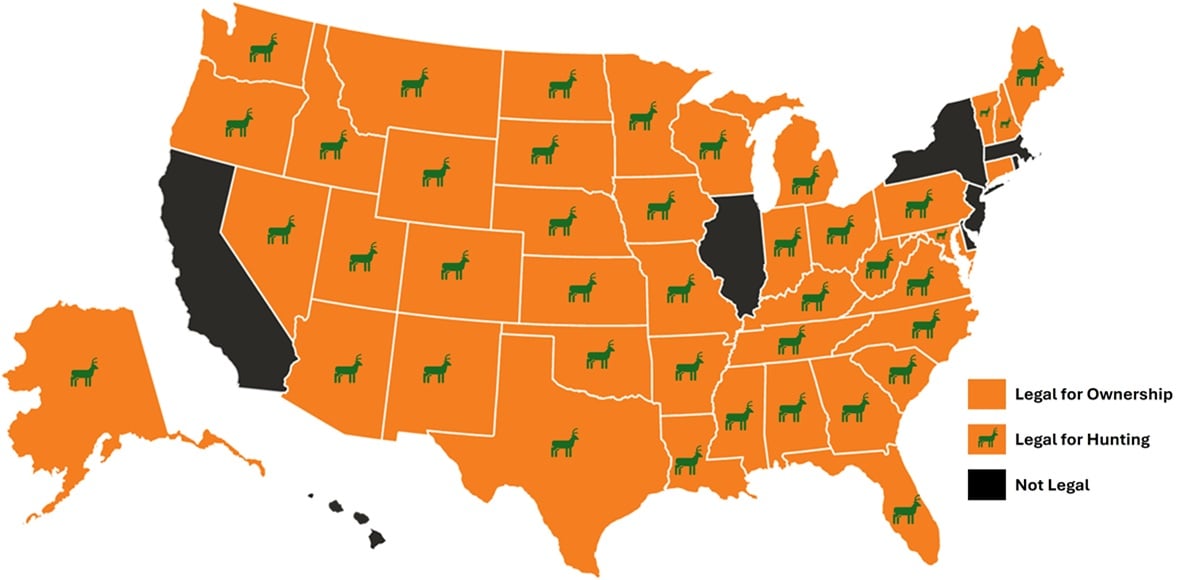
Yes, silencers, also known as suppressors, are legal in most of the United States. At present, 42 states permit civilian ownership of suppressors, and 41 of those states also allow their use while hunting (See the above Map).
Many hunters choose suppressors to help protect their hearing and minimize noise impact on surrounding areas. The good news is that if suppressor ownership is legal in your state, hunting with one is very likely legal as well
So what does it take to own a suppressor? In states where they are allowed, the requirement is straightforward: if you can legally own a firearm, you can legally own a suppressor, provided you follow the required federal and state regulations.
Which States Allow Suppressor Ownership?
Suppressors are legal in 42 out of 50 states, meaning roughly 84% of the U.S. population lives in a state where ownership is permitted.
While the majority of Americans have access, there are still a few exceptions. Suppressor ownership is currently prohibited in the following states:
- California
- Delaware
- Hawaii
- Illinois
- Massachusetts
- New York
- New Jersey
- Rhode Island
Suppressors are also illegal in the District of Columbia. Advocacy efforts continue in these regions, and we closely monitor any legislative changes that could expand legal ownership in the future.
Where Is It Legal to Hunt with a Suppressor?
Hunting with a suppressor is legal in 41 of the 42 states that allow suppressor ownership.
The lone exception is Connecticut, where suppressors are legal to own but not permitted for hunting use. Encouragingly, state laws have trended in a positive direction.
Since 2011, 19 states have passed legislation allowing suppressors for hunting, reflecting growing awareness of their benefits for hearing safety and wildlife management.
With continued progress, it’s possible that all remaining states may eventually follow suit.
Legal Requirements (ATF Form 4)
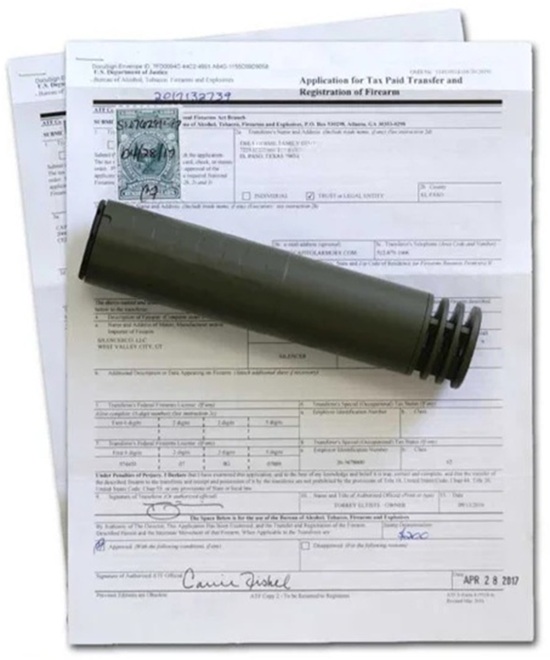
Buying a suppressor (also known as a silencer) is legal under federal law, but it comes with additional steps compared to purchasing a standard firearm.
Suppressors are regulated by the National Firearms Act (NFA), which means buyers must meet specific eligibility criteria and complete detailed paperwork before approval.
Basic Eligibility Requirements
To legally purchase and own a suppressor, you must:
- Live in a state where suppressors are legal
- State law must explicitly allow suppressor ownership
- Be a U.S. resident
- Federal law restricts suppressor ownership to United States residents
- Meet age requirements
You must be at least 21 years old when purchasing from a licensed dealer, or 18 years old if buying from a private individual where allowed.
Be legally eligible to purchase a firearm. This includes passing a federal background check and meeting all firearm ownership laws.
Paperwork, Fingerprints, and Notifications
As part of the approval process, you’ll need to complete additional documentation:
- Submit ATF Form 4, which registers the suppressor to you
- Provide fingerprints and a passport-style photograph, similar to the requirements for a U.S. passport
- Notify your Chief Law Enforcement Officer (CLEO) by supplying them with a copy of your Form 4. *Most suppressor dealers handle this step on your behalf
eForm 4 vs. Paper Filing
Many buyers now choose to file electronically using the ATF’s eForm 4 system:
- Electronic submissions typically process faster than traditional paper forms
- You can track your application status online, making the wait more transparent
Keep in mind that suppressor paperwork involves multiple pages and copies sent to different agencies, and while dealers often assist with the process, accuracy is critical to avoid delays.
Silencer Central helps ensure all required documents are completed correctly on your behalf, making the ATF approval process easy so you can lawfully purchase and own a suppressor while remaining fully compliant with federal and state regulations.
Fingerprints for ATF Form 4
Why do I need to do fingerprints for the ATF?
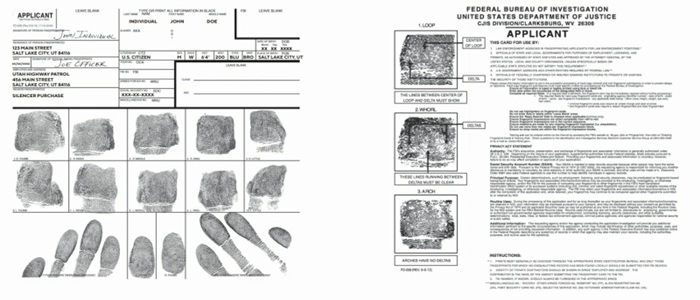
The ATF requires fingerprints to be submitted on the FD-258 Fingerprint Card, in order to conduct a thorough background check for certain firearm-related activities, like purchasing or transferring National Firearms Act (NFA) items. The purpose of this is to ensure the applicant’s eligibility for possessing or handling these controlled items.
Will my dealer offer fingerprint services?
You do not need your dealer to take fingerprints. Once you purchase a suppressor from us, we handle this step directly.
After your order is placed, we send you a free fingerprint kit so you can complete your fingerprints without delays or extra costs. You choose how you want to do it, at home or locally, and we take it from there.
Our goal is simple: Remove any friction and keep your suppressor paperwork moving.
How do I obtain my fingerprints?
To move your suppressor paperwork forward, fingerprints are required. We make this easy and flexible.
CHOOSE ONE OF THE FOLLOWING OPTIONS:
1. At-home option (Most Popular)
We mail you a free FD-258 fingerprint card kit with clear instructions and a return envelope. You can take your fingerprints yourself, many customers do, or with help from someone you trust.
If you have questions, our team is available to guide you. Mail the completed card back to us, and we handle the electronic filing with the ATF.
2. Local Option
Prefer a professional setting? Bring your free fingerprint kit to a specialized fingerprinting center, police or sheriff’s office, select UPS Stores, or the post office.
Availability varies, so always check ahead. Once completed, send the card back using the included envelope.
*Pick what’s easiest for you. Once your fingerprints are complete, we keep everything moving and take care of the ATF submission.
What if I don't send fingerprints with my ATF Form 4?
If you do not submit your fingerprints, your Form 4 will be rejected and you will have to resubmit. The same is true if your Form 4 gets lost in the mail. To ensure that your submission is not lost in the mail, it’s a good idea to submit a digital EFT with an eForm 4.
Silencer / Suppressor FAQs (Highlights)
QUESTION: Are pistol silencers legal?
ANSWER: Yes, pistol silencers are legal. Silencers, while regulated, actually make guns safer for everyone. They reduce the risk of hearing loss, allowing gun owners to operate without earplugs, which in turn, helps them be much more aware of their surroundings.
QUESTION: Do pistol silencers work?
ANSWER: Yes, absolutely. Silencers offer many of the same benefits to pistol shooters as they do to rifle and shotgun shooters. Even the best Pistol silencers tend to get a bad rap because unlike rifles or shotguns, pistols are often bought to conceal or be discreet.
QUESTION: How loud is a silenced pistol?
ANSWER: How loud a suppressed pistol is depends greatly upon the caliber being fired and the suppressor being used. Unlike in the movies, a silencer won’t give you a completely soundless bullet whispering through the air. The word “suppressor” is really more accurate because these products suppress the sound of a gun rather than silence it.
QUESTION: What pistols can have silencers?
ANSWER: Most standard pistols can be used with silencers, but we recommend talking with our team to know for sure if your pistol is ideal for being used with a silencer.
QUESTION: Are rifle silencers illegal?
ANSWER: No, rifle silencers are actually legal in 42 U.S. states. Only 9 states (California, Illinois, New York, New Jersey, Massachusetts, Rhode Island, Delaware, Hawaii and Washington D.C). ban individual ownership of silencers or suppressors.
QUESTION: Can you put a silencer on a rifle?
ANSWER: Absolutely. In fact, rifles are by far the most common type of firearm on which to mount a silencer. Like rifles, silencers are common among hunters. Your hunting rifle should definitely have a silencer, because first and foremost, they reduce noise pollution. Meaning you’re not going to scare off every critter in a 10 mile radius.
QUESTION: What is the quietest rifle suppressor?
ANSWER: Well the jury’s out on this one, because there is so much that affects a suppressor’s dB testing at any given time. A gunshot’s volume, measured in decibels, or “dB”, depends on the weight, caliber, and speed of the bullet, the length of the barrel, not to mention how fast the gunpowder is burning. A gunshot can also be impacted by something as simple as temperature or humidity.
QUESTION: How do rifle suppressors work?
ANSWER: When you fire a round, burning gas builds up pressure behind the bullet and thrusts it down your bore. When the bullet leaves, a burst of host gas exists behind it, releasing a loud noise. In comes a silencer. A silencer slows down the gas by redirecting it through a series of baffles before it can escape the silencer. This allows any unburnt powder to finish burning off, which reduces muzzle flash. It also gives the gas more time to slow down and cool, so that when it does escape the silencer, it’s moving slower and under less pressure, which means it’s also quieter.
QUESTION: Are shotgun silencers illegal?
ANSWER: No, shotgun silencers are absolutely not illegal. With the exception of a few homebrew, DIY contraptions, all silencers are legal in 42 of our great 50 states. Only California, Illinois, New York, New Jersey, Massachusetts, Rhode Island, Delaware, Hawaii, and Washington D.C. ban individual silencer ownership.
QUESTION: How much faster will the Electronic Form 4 be?
ANSWER: When it comes to the government – and especially the ATF – one can never know for sure. Presently, we don’t know how much faster it will be. With that said, our research based on previous electronic Form 4 approvals and the current electronic Form 1 approvals suggests that once this process gets rolling, the total time needed to secure a transfer approval of a silencer should be reduced from the current 10 months (or more) wait time, to an approximate 150 days.
QUESTION: How will the eForms process change for me, the customer?
ANSWER: The biggest change for the customer will be to acquire your username and PIN from the ATF. To create an eForms account, visit eforms.atf.gov to start the process. You will then receive your username from the ATF (they pick it, you do not) and choose a password and PIN (you pick it, they do not).
QUESTION: How will the Electronic Form 4 speed up the process?
ANSWER: The ATF’s new electronic version of the Form 4 will greatly expedite the time required to make these transfers. When a transfer applicant or dealer enters the data electronically, the data will now be transmitted digitally. This cuts out the repetitive need for data entry and validation.
QUESTION: If I file as an individual, can I add a trust at a later date?
ANSWER: Yes, you can add any silencer to a trust after you buy it by filing as an individual. Just keep in mind a few things. You will need to have legal help is setting up the new trust and adding in the silencer. There will likely be fees involved, but we can’t predict what those will be. There is also the issue of a tax stamp. If you transfer your silencer to a trust, you will need to buy a new tax stamp for it under the trust, according to the ATF.
QUESTION: If I file as an individual, will I really get my silencer faster?
ANSWER: The short answer is yes, you likely will – for now. Approval times for trusts are speeding up, and batch approvals are happening, too. We have been working with the ATF to help make the process for trusts faster, but individual approvals are currently faster.
QUESTION: What if my paperwork has already been submitted to the ATF?
ANSWER: If you have already started your application through the paper-process, then you will need to stay on that path. It is not recommended to withdraw paper applications.
QUESTION: What if you don’t want to file electronically?
ANSWER: The paper version will still be an option. If for any reason you decide you would rather submit on paper, you certainly can. The wait time will remain similar to what it is currently.
QUESTION: What is ATF Form 4 eForm?
ANSWER:ATF electronic Form 4’s will change the Form 4 from a paper process to an entirely digital process. This will speed up the process of buying and waiting for approval.
QUESTION: What is the new pin number process and how do I set it up?
ANSWER: The most important change that the ATF has made is the usage and creation of a PIN that will help submit your form digitally. This process will be similar to the pins that have been used for years with ATF Forms 1, 2, 3, 4, 5, and 6. To create an eForms account, visit eforms.atf.gov to start the process. You will then receive your username from the ATF (they pick it, you do not) and choose a password and PIN (you pick it, they do not).
QUESTION: What makes paper-based Form 4 transfers so slow?
ANSWER: There are two logical answers to this question. The first is the time it takes for paperwork to make it through the mail, and with postal reliability these days, there’s no telling when your paperwork may actually arrive. Thankfully, that’s now a thing of the past! The second reason is the amount of time devoted to data entry. When a silencer dealer or individual sends completed paperwork to the ATF to secure permission for a Form 4 transfer, employees at the ATF have to manually enter the data from the forms. (Yes, that’s right: the ATF takes your paper form and enters it into a computer instead of just having you enter it electronically in the first place.) As you can imagine, this is a time-consuming process. The data must be entered, and then checked, and this process is typically taking upwards of 9 months as of the time of writing.
QUESTION: Which is better - Trust or Individual?
ANSWER: The real answer to this is that it is entirely up to you. Only you can decide what works best for your circumstances. It’s pretty obvious that we tend to prefer trusts for the flexibility they provide. That’s why we offer trust setup as a free service. However, we also see the benefit to individual filing, as you will likely get your silencer faster. Go through all the pros and cons to each and just know that we’re here to help you regardless of what you choose.
QUESTION: Will ATF eForms reduce wait times?
ANSWER: Yes, we anticipate a significant decrease in wait times once the ATF eForm 4 is launched.
QUESTION: Will filing as a trust ever be as fast as filing as an individual?
ANSWER: That is the goal that we and the ATF are working toward. We are always looking at how we can optimize our process, and we work with the ATF to see what can be done better. The ATF has told us that they are adding more staff and are working toward having the approval process be as close to equal as possible. But it isn’t there yet. We will keep everyone informed.
QUESTION: Am I "grandfathered" in after I purchase my first suppressor?
ANSWER: No, when you purchase your next suppressor you will still need to complete the ATF application process, and wait for approval.
QUESTION: If I file as an individual, can I add a trust at a later date?
ANSWER: Yes, you can add any silencer to a trust after you buy it by filing as an individual. Just keep in mind a few things. You will need to have legal help is setting up the new trust and adding in the silencer. There will likely be fees involved, but we can’t predict what those will be. There is also the issue of a tax stamp. If you transfer your silencer to a trust, you will need to buy a new tax stamp for it under the trust, according to the ATF.
QUESTION: Which is better - Trust or Individual?
ANSWER: The real answer to this is that it is entirely up to you. Only you can decide what works best for your circumstances. It’s pretty obvious that we tend to prefer trusts for the flexibility they provide. That’s why we offer trust setup as a free service. However, we also see the benefit to individual filing, as you will likely get your silencer faster. Go through all the pros and cons to each and just know that we’re here to help you regardless of what you choose.
QUESTION: Will filing as a trust ever be as fast as filing as an individual?
ANSWER: That is the goal that we and the ATF are working toward. We are always looking at how we can optimize our process, and we work with the ATF to see what can be done better. The ATF has told us that they are adding more staff and are working toward having the approval process be as close to equal as possible. But it isn’t there yet. We will keep everyone informed.
QUESTION: What states can I hunt game with with a silencer?
ANSWER: You can hunt all game animals with a silencer in the the following states: Alabama, Arizona, Colorado, Florida, Georgia, Iowa, Kansas, Michigan, Minnesota, Montana, Nebraska, North Carolina, North Dakota, South Dakota, Tennessee, Texas, Wisconsin and Wyoming.
QUESTION: Can I use one silencer for multiple firearms?
ANSWER: Yes. Buy one silencer and you can use it on all guns of smaller caliber. For example, if you bought the Banish 30 Multi-Caliber Suppressor, it will work with all of your rifle calibers from .17 to .30 caliber magnums.
QUESTION: How Do I Get My Silencer After It Has Been Approved?
ANSWER:
- When you apply for approval, you will also receive an email with instructions on how to complete the required Form 4473. Once the form is completed, we’ll send you a signature request to review and digitally sign.
- We are required to notify your local law enforcement agency that we are shipping your silencer(s) to you. We must wait 7 days after confirmed delivery of this notification before we can ship to you. This will happen when the Form 4473 is signed. These steps are now done to reduce your wait times.
- You will receive a shipping notification with tracking information once we prepare your order to ship. Please note: tracking may not be live for 1-3 business days. *Adult signature is required at the time of delivery.
QUESTION: How do I take a passport-style photo?
ANSWER: Your ATF Form 4 application must include a passport style photo. Here are some tips to take the best picture:
- The image will be cropped to a 2″x2″ square size.
- The photo should be taken in front of a solid white background.
- Photos must be taken in full face view. The top of your head and your shoulders need to be in full view (there should be white space above your head).
- Remove any head coverings that would obscure your hair or hairline, including sunglasses, hats, toupees
QUESTION: If I file as an individual, will I really get my silencer faster?
ANSWER: The short answer is yes, you likely will – for now. Approval times for trusts are speeding up, and batch approvals are happening, too. We have been working with the ATF to help make the process for trusts faster, but individual approvals are currently faster.
QUESTION: Do I Need to Have a Class 3 License to Purchase a Silencer?
ANSWER: No! The best way to think of a silencer purchase is as a “title” transfer between our company and your Gun Trust or to you directly. While ATF must approve this transfer (which we will assist with), you do not physically need your own license to make a purchase.
QUESTION: Is There a Federal Tax Involved in Purchasing a Silencer?
ANSWER: There is a $200 Tax Stamp required per silencer. This fee is tax deductible and is a one-time fee. The best way to conceptualize this fee is as a title transfer tax.
Contact Information
Need Assistance? We’re Here to Help!
At Ammunition Depot, your questions and concerns matter. Our knowledgeable support team is ready to assist you, just give us a call on our dedicated and secure phone line at 1-877-904-2132.
Reliable help is only a phone call away.